

Wood's CRW, Your construction equipment Partner, providing the most complete equipment Solutions to help your company achieve long term Success.
PARTNER NEWS
D.A. Collins Completes Erie Canal Work with 248 HYLAB and ATC-3275
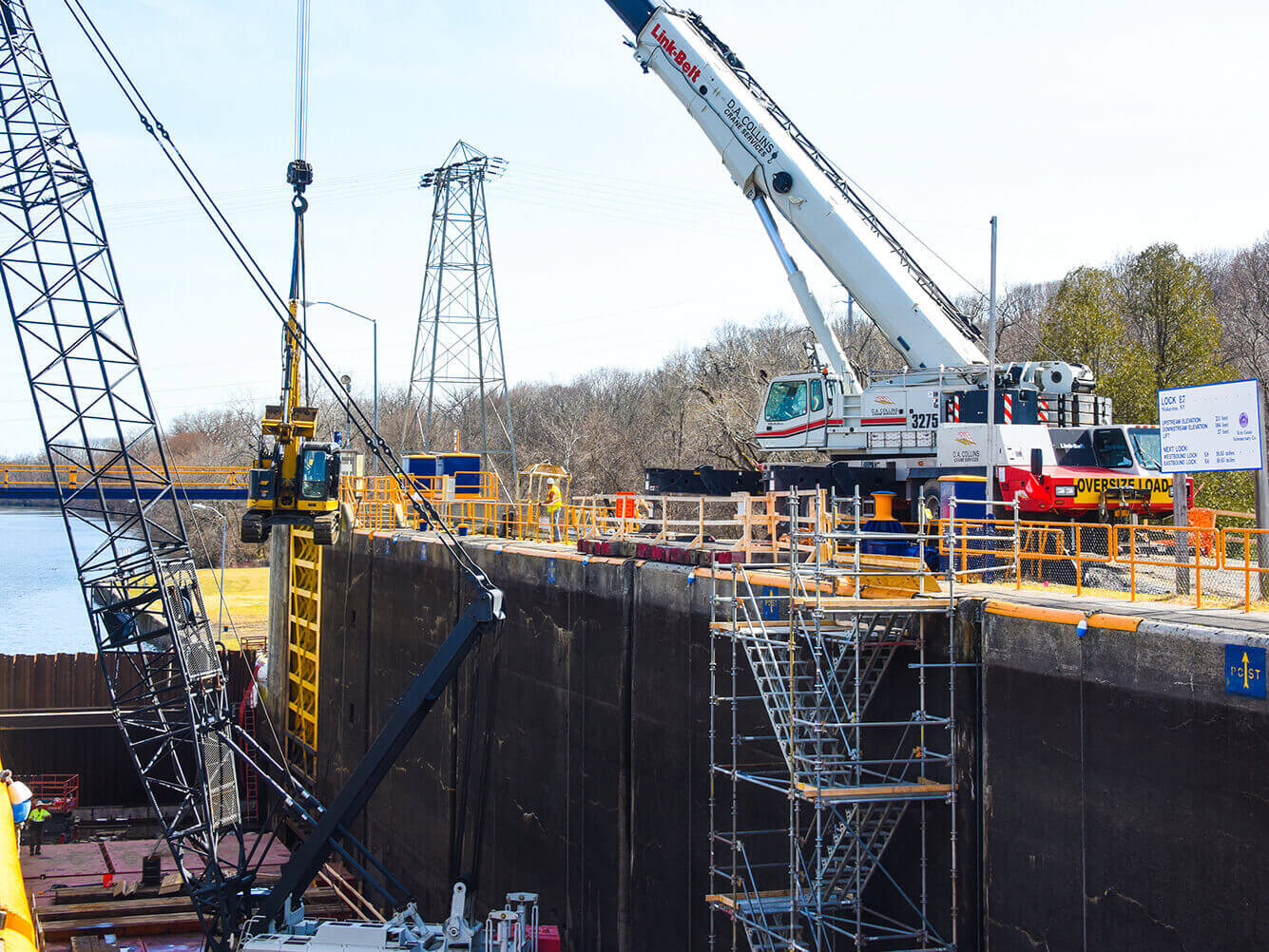
D.A. Collins of Wilton, New York used their 200-ton Link-Belt 248 HYLAB 5 lattice crawler crane and 275-ton Link-Belt ATC-3275 all-terrain crane for refurbishment of the lock’s key components – valves, gates, electrical, and concrete basin as part of New York State Canal Corporation’s emergency repair program regarding Erie Canal Lock E-7 in Niskayuna, New York.
Following installation of sheet piling and draining the lock with a coffer dam, DA Collins lowered the 248 HYLAB 5 crane down into the dry lock using their own ATC-3275 all-terrain crane, in order to lift, remove, and position the 100,000 lb. lock gates for repairs.
The 248 HYLAB rested on timber planks over a group of 7 ft. tall Flexifloat barges that rose if prolonged rainfall flooded the lock.
For operation inside the lock, the 248 HYLAB 5 was outfitted with 90 ft. of boom to ensure proper motion of the lock gates when they were lifted and moved for maintenance. Steel ramps on either side of the centered floating barge allowed the 248 HYLAB 5 to navigate the full length of the base floor of the lock. Anything beyond the perimeter of the lock footprint, the ATC-3275 was used to reach from above with its full boom and attachment.
According to D.A. Collins crane operator Bill Staley, because of the ATC-3275’s long 223 ft. reach and lift capability, he could reach any of the 45 ft. wide by 328 ft. long lock easily.
R.S. Audley & the Link-Belt TCC-1400
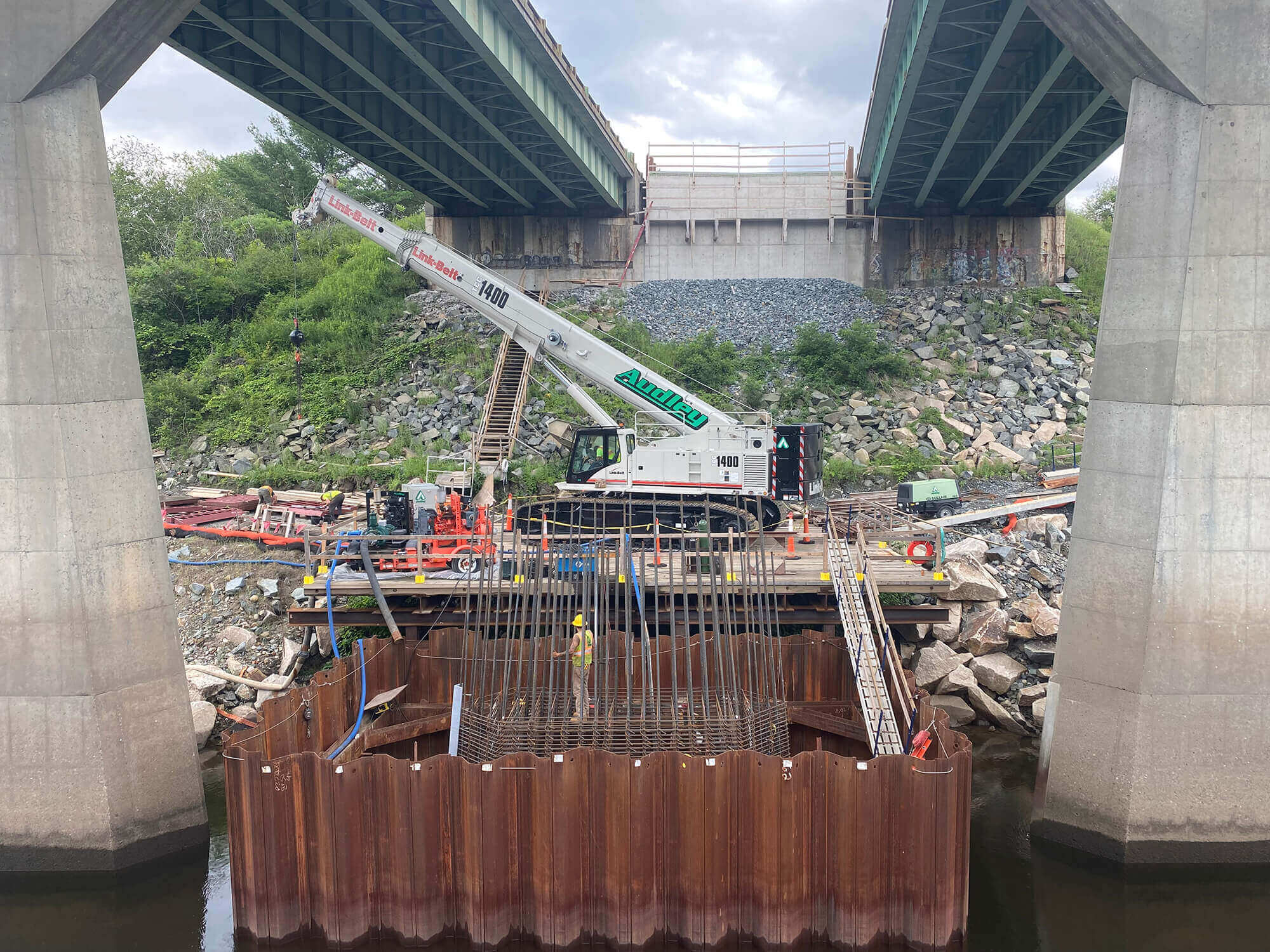
R.S. Audley recently purchased a brand-new Link-Belt TCC-1400 for the rebuild of two I-89 bridges over the Connecticut River in Lebanon, N.H. Founded by Robert S. Audley in 1955, R.S. Audley, Inc. is a general contractor with a focus on roads, bridges, utilities, large site work, and unique structural projects throughout northern New England.
There were several reasons why Audley partnered with CRW and the Link-Belt TCC-1400 according to Scott Stevens, Vice President and Bridge Engineer. “Overall maneuverability and flexibility of available working configurations.” Also, “We knew we needed a telescopic crawler to sneak a 140- Ton class crane under the existing bridges, but the ability to scope in and out under full load, is what solidified the fact that we would be purchasing a Link-Belt.”